

A $40-a-year IPTV subscription freezes on game night for a simple reason: at that price, there is no money for the bandwidth that five thousand households consume when they all watch the Leafs or the Canadiens at once. The service holds up on a weekday, when nobody is watching, and collapses at 7 p.m. on Saturday. It is neither bad luck nor your internet connection: it is arithmetic. Here is what a subscription actually pays for, why $5-a-month offers cannot hold, and how to check before paying.
What happens at 7 p.m. on game night
An IPTV server does not “broadcast” once for everyone: each viewer receives their own stream. When 5,000 subscribers open Sportsnet at the same moment, the server must push 5,000 streams of 6 Mbps — 30 Gbps, the equivalent of a few thousand home connections. Two things give way first:
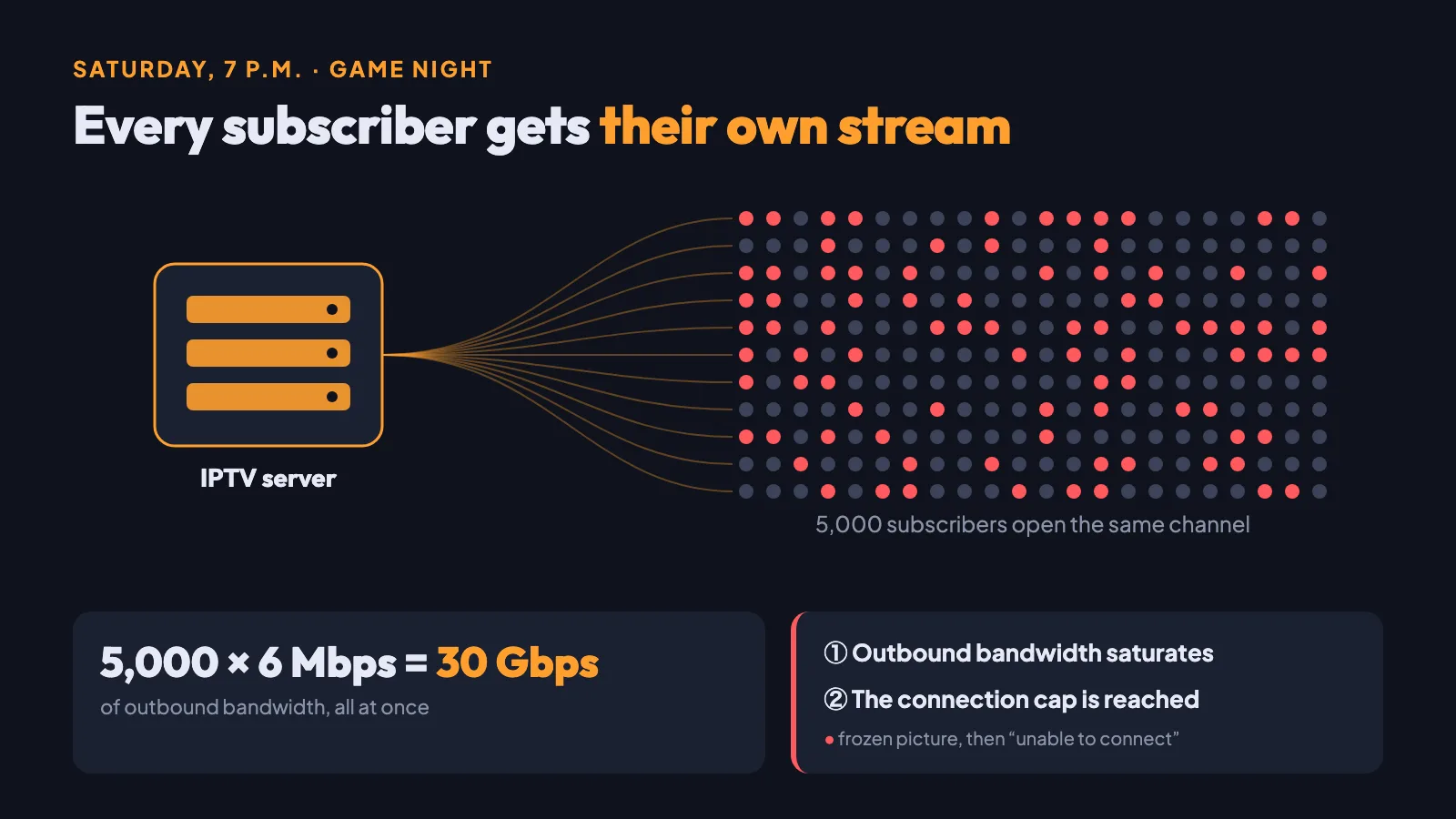
- Outbound bandwidth: rented by the gigabit from the host, it costs more than everything else. A service selling at $3 a month rents the bare minimum and saturates as soon as the audience climbs.
- The number of simultaneous connections the server accepts. Beyond it, it refuses or slows down: the picture freezes, then “unable to connect”.
A movie at 10 p.m. plays fine on those same services — which is why a free trial on a Tuesday night proves nothing.
What a serious subscription pays for
Servers in Canada
A server in Montréal or Toronto answers a Canadian household in 10 to 20 ms; one in Europe or Asia in 100 to 200 ms, with packet loss on transatlantic links at peak hours. Canadian hosting costs 2 to 3 times more.
Bandwidth sized for the peak
Not for the average. The difference between a service that holds on Saturday night and one that does not is capacity paid for all year to serve 3 hours a week.
People watching over it
Load balancing between servers (Duck, Raccoon, Edge, Trex), adaptive streams that drop from 4K to HD when your connection dips, a dead feed restarted before you notice, and a chat that answers during the game.
Add player licences, the client portal, Interac payments and bilingual support: at $7.50 (yearly) to $20 (monthly) a month, IPTV Québec HD covers those costs with a normal margin. At $3 a month something has to be cut — and it is always bandwidth and support.
How to spot an under-provisioned service
- Under $6 a month on a yearly plan: mathematically impossible to sustain with servers in Canada.
- “20,000 channels, 4 devices, for life”: the bigger the promise, the less capacity per subscriber.
- Sold on Telegram, paid by gift card: no structural costs, so no structure.
- No paid trial: a $2 or $3 trial on a game night is the only honest test; a free 2-hour trial on a Tuesday is not.
- A VPN required: often to get around blocking orders, a sign the service is in the crosshairs — see Is IPTV legal in Canada?.
What still depends on you
A well-provisioned service can still freeze at your place if:
- you are on 2.4 GHz Wi-Fi behind two walls — switch to 5 GHz or Ethernet;
- your connection drops under 25 Mbps at game time (test on fast.com at 7 p.m., not at noon) — pick the HD feed rather than 4K;
- the app cache has not been cleared in months;
- your box is a $40 generic Android decoding 4K in software.
Our Firestick install guide covers these cases, and the setup guide gives the right settings for every device.
The test that settles it
Take the 24-hour trial for $2.99 and open Sportsnet or RDS during a Leafs or Canadiens game, on your TV, over your connection. If the picture holds when the whole country is watching, it will hold the rest of the year. That is exactly what $3 services will never let you verify.
In short
Cheap IPTV does not freeze by bad luck: it freezes because the price covers neither peak bandwidth, nor servers in Canada, nor someone to watch over it. Budget $7.50 to $20 a month for a service that holds on game nights — full price breakdown here — and always test during a game before committing.